[Q51-Q70] Ultimate Guide to Prepare MuleSoft-Integration-Architect-I with Accurate PDF Questions [Aug 18, 2025]

5/5 - (1 vote)

Ultimate Guide to Prepare MuleSoft-Integration-Architect-I with Accurate PDF Questions [Aug 18, 2025]

Pass Salesforce With TestBraindump Exam Dumps

Salesforce MuleSoft-Integration-Architect-I Exam Syllabus Topics:

Topic Details
Topic 1
  • Designing Integration Solutions to Meet Persistence Requirements: It addresses the usage of VM queues and connectors, object stores and services, and stateful components configured with object stores.
Topic 2
  • Designing Automated Tests for Mule Applications: This topic covers unit test suites, and scenarios for integration and performance testing.
Topic 3
  • Applying DevOps Practices and Operating Integration Solutions: Its sub-topics are related to designing CI
  • CD pipelines with MuleSoft plugins, automating interactions with Anypoint Platform, designing logging configurations, and identifying Anypoint Monitoring features.
Topic 4
  • Designing for the Runtime Plane Technology Architecture: It includes analyzing Mule runtime clusters, designing solutions for CloudHub, choosing Mule runtime domains, leveraging Mule 4 class loader isolation, and understanding the reactive event processing model.
Topic 5
  • Designing Integration Solutions to Meet Security Requirements: This topic emphasizes securing access to the Anypoint Platform and APIs, using Anypoint Security, counteracting security vulnerabilities, and understanding audit logging capabilities.
Topic 6
  • Designing Architecture Using Integration Paradigms: This topic focuses on creating high-level integration architectures using various paradigms. It includes API-led connectivity, web APIs and HTTP, event-driven APIs, and message brokers, and designing Mule application using messaging patterns and technologies.
Topic 7
  • Initiating Integration Solutions on Anypoint Platform: Summarizing MuleSoft Catalyst and Catalyst Knowledge Hub, differentiating between functional and non-functional requirements, selecting features for designing and managing APIs, and choosing deployment options are its sub-topics.
Topic 8
  • Designing Integration Solutions to Meet Reliability Requirements: It includes selecting alternatives to traditional transactions, recognizing the purpose of various scopes and strategies, differentiating disaster recovery and high availability, and using local and XA transactions.


NEW QUESTION 51
A payment processing company has implemented a Payment Processing API Mule application to process credit card and debit card transactions, Because the Payment Processing API handles highly sensitive information, the payment processing company requires that data must be encrypted both In-transit and at-rest.
To meet these security requirements, consumers of the Payment Processing API must create request message payloads in a JSON format specified by the API, and the message payload values must be encrypted.
How can the Payment Processing API validate requests received from API consumers?


NEW QUESTION 52
A company is planning to migrate its deployment environment from on-premises cluster to a Runtime Fabric (RTF) cluster. It also has a requirement to enable Mule applications deployed to a Mule runtime instance to store and share data across application replicas and restarts.
How can these requirements be met?


NEW QUESTION 53
An integration team follows MuleSoft’s recommended approach to full lifecycle API development.
Which activity should this team perform during the API implementation phase?


NEW QUESTION 54
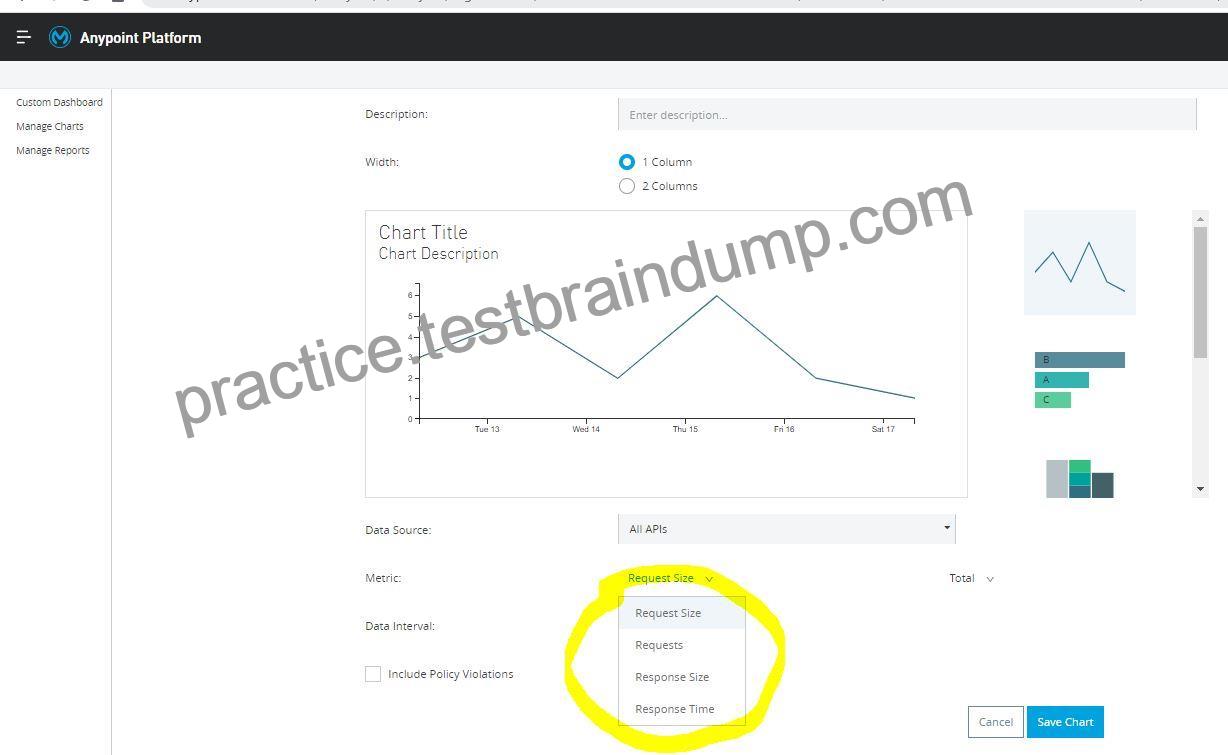
What metrics about API invocations are available for visualization in custom charts using Anypoint Analytics?


NEW QUESTION 55
A new Mule application under development must implement extensive data transformation logic. Some of the data transformation functionality is already available as external transformation services that are mature and widely used across the organization; the rest is highly specific to the new Mule application.
The organization follows a rigorous testing approach, where every service and application must be extensively acceptance tested before it is allowed to go into production.
What is the best way to implement the data transformation logic for this new Mule application while minimizing the overall testing effort?


NEW QUESTION 56
How does timeout attribute help inform design decisions while using JMS connector listening for incoming messages in an extended architecture (XA) transaction?


NEW QUESTION 57
As a part of project , existing java implementation is being migrated to Mulesoft. Business is very tight on the budget and wish to complete the project in most economical way possible.
Canonical object model using java is already a part of existing implementation. Same object model is required by mule application for a business use case. What is the best way to achieve this?


NEW QUESTION 58
According to MuleSoft, which deployment characteristic applies to a microservices application architecture?


NEW QUESTION 59
What Is a recommended practice when designing an integration Mule 4 application that reads a large XML payload as a stream?


NEW QUESTION 60
A customer wants to use the mapped diagnostic context (MDC) and logging variables to enrich its logging and improve tracking by providing more context in the logs.
The customer also wants to improve the throughput and lower the latency of message processing.
As an Mulesoft integration architect can you advise, what should the customer implement to meet these requirements?


NEW QUESTION 61
Which Anypoint Platform component should a MuleSoft developer use to create an API specification prior to building the API implementation?


NEW QUESTION 62
An API implementation is being developed to expose data from a production database via HTTP requests.
The API implementation executes a database SELECT statement that is dynamically created based upon data received from each incoming HTTP request. The developers are planning to use various types of testing to make sure the Mule application works as expected, can handle specific workloads, and behaves correctly from an API consumer perspective. What type of testing would typically mock the results from each SELECT statement rather than actually execute it in the production database?


NEW QUESTION 63
In one of the critical payment related mule application, transaction is being used . As an enhancement to implementation , scatter gather route is introduced which is also the part of transaction group. Scatter gather route has 4 routes.
What will be the behavior of the Mule application in case of error occurs in 4th route of the scatter-gather router and transaction needs to be rolled back?


NEW QUESTION 64
A banking company is developing a new set of APIs for its online business. One of the critical API’s is a master lookup API which is a system API. This master lookup API uses persistent object store. This API will be used by all other APIs to provide master lookup data.

Master lookup API is deployed on two cloudhub workers of 0.1 vCore each because there is a lot of master data to be cached. Master lookup data is stored as a key value pair. The cache gets refreshed if they key is not found in the cache.
Doing performance testing it was observed that the Master lookup API has a higher response time due to database queries execution to fetch the master lookup data.
Due to this performance issue, go-live of the online business is on hold which could cause potential financial loss to Bank.
As an integration architect, which of the below option you would suggest to resolve performance issue?


NEW QUESTION 65
Refer to the exhibit.

A business process involves the receipt of a file from an external vendor over SFTP. The file needs to be parsed and its content processed, validated, and ultimately persisted to a database. The delivery mechanism is expected to change in the future as more vendors send similar files using other mechanisms such as file transfer or HTTP POST.
What is the most effective way to design for these requirements in order to minimize the impact of future change?


NEW QUESTION 66
The company’s FTPS server login username and password


NEW QUESTION 67
A retail company is implementing a MuleSoft API to get inventory details from two vendors by Invoking each vendor’s online applications. Due to network issues, the invocations to the vendor applications are timing out intermittently, but the requests are successful after re-invoking each vendor application.
What is the most performant way of implementing the API to invoke each vendor application and to retry invocations that generate timeout errors?


NEW QUESTION 68
An IT integration delivery team begins a project by gathering all of the requirements, and proceeds to execute the remaining project activities as sequential, non-repeating phases.
Which IT project delivery methodology is this team following?


NEW QUESTION 69
An organization is designing an integration Mule application to process orders by submitting them to a back-end system for offline processing. Each order will be received by the Mule application through an HTTPS POST and must be acknowledged immediately. Once acknowledged, the order will be submitted to a back-end system. Orders that cannot be successfully submitted due to rejections from the back-end system will need to be processed manually (outside the back-end system).
The Mule application will be deployed to a customer-hosted runtime and is able to use an existing ActiveMQ broker if needed. The ActiveMQ broker is located inside the organization’s firewall. The back-end system has a track record of unreliability due to both minor network connectivity issues and longer outages.
What idiomatic (used for their intended purposes) combination of Mule application components and ActiveMQ queues are required to ensure automatic submission of orders to the back-end system while supporting but minimizing manual order processing?


NEW QUESTION 70
Refer to the exhibit.


A business process involves two APIs that interact with each other asynchronously over HTTP. Each API is implemented as a Mule application. API 1 receives the initial HTTP request and invokes API 2 (in a fire and forget fashion) while API 2, upon completion of the processing, calls back into API l to notify about completion of the asynchronous process.
Each API Is deployed to multiple redundant Mule runtimes and a separate load balancer, and is deployed to a separate network zone.
In the network architecture, how must the firewall rules be configured to enable the above Interaction between API 1 and API 2?


Latest MuleSoft-Integration-Architect-I Exam Dumps – Valid and Updated Dumps: https://www.testbraindump.com/MuleSoft-Integration-Architect-I-exam-prep.html

Related Links: www.stes.tyc.edu.tw onlyfans.com www.stes.tyc.edu.tw www.stes.tyc.edu.tw www.stes.tyc.edu.tw www.stes.tyc.edu.tw

Leave a Reply

Your email address will not be published. Required fields are marked *

Enter the text from the image below